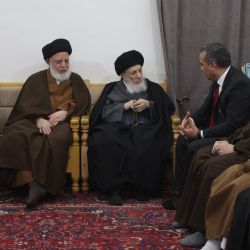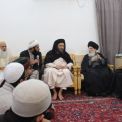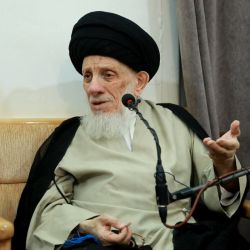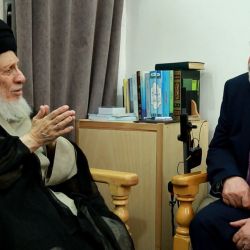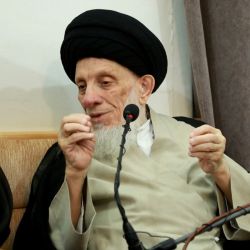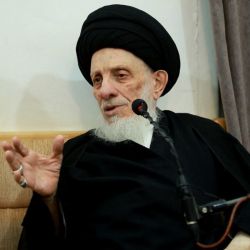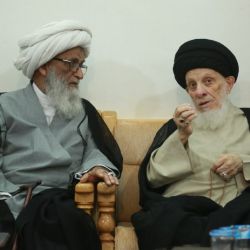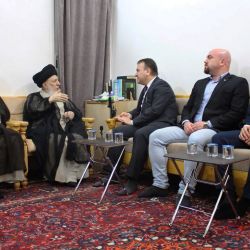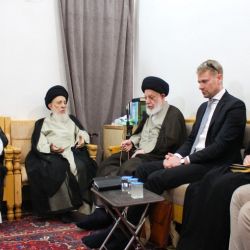
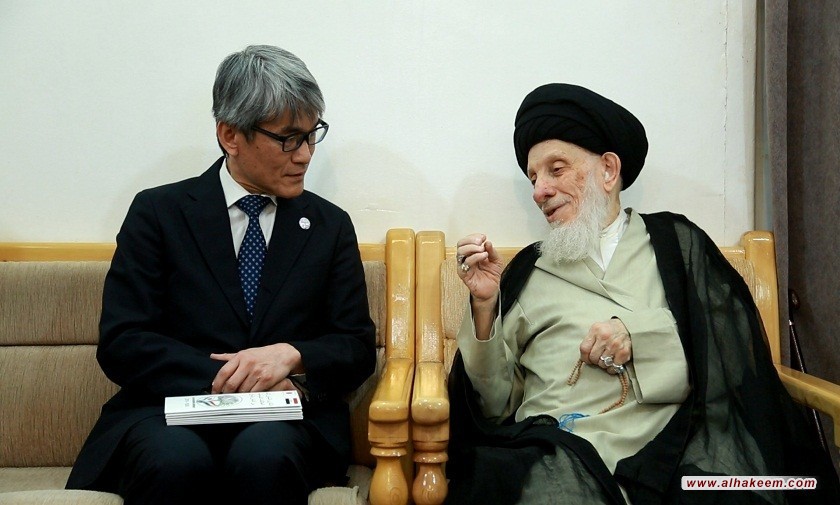
His Eminence, Grand Ayatollah al-Hakeem, receives the Japanese Ambassador to Iraq and Clarifies the Importance of Entrenching the Correct Religious Understandings in Societies.

His Eminence, Grand Ayatollah al-Hakeem, receives the Japanese Ambassador to Iraq and Clarifies the Importance of Entrenching the Correct Religious Understandings in Societies.
2019/04/23

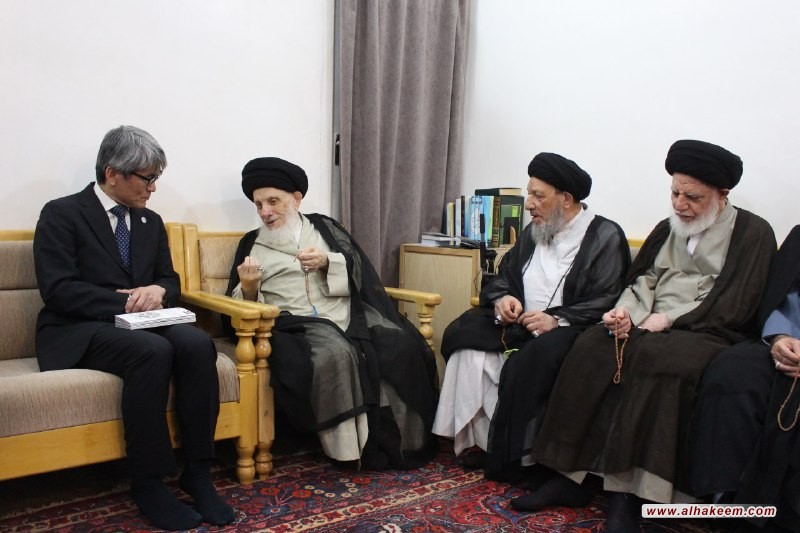
His Eminence Grand Ayatollah Sayyid Mohammed Saeed al-Hakeem received Mr. Naufumi Hashimoto, the new Ambassador of Japan to Iraq, on Tuesday 23 April 2019.

His Eminence clarified to the guest the importance of entrenching the correct religious understandings in societies, in order to safeguard the society from the destruction lofty moral codes.

His Eminence explained the role of Marji'iyya and the Hawza (Islamic Seminary) in having the correct religious, humanitarian and ethical understandings firmly rooted amongst people, in order for them to preserve their identity. Thus society can keep to the great values of Islam which come from the instructions of God Almighty in the Holy Quran and the lives of the Holy Infallibles (peace be upon them). Through attaching oneself to such values, one will be able to defend himself, his land and those things which he deems sanctified, without the need of having such weaponry that the enemies may have, in terms of preparedness and quantity. He reverts to his origin in his religion, his creed and his noble values.

Were it not for all this, people of Iraq would not have been able to defeat the great challenges that they faced of recent times.

His Eminence also mentioned the necessity and importance of communication between different human communities.

The guest expressed his utmost happiness in having this opportunity to meet him, and appreciated the positive role of Marji'iyya in serving society.
Day Questions

Is it allowed to put on some basic make-up on, that includes just the foundation and lipstick, as is common in our society amongst women?

It is prohibited to do so even if it is commonly used by society. It is unlawful for a woman to reveal her beauty in the presence of non-mahram men, except for the kohl applied on eyes and the ring on the finger.

Is knowing politics, economics and other worldly sciences a condition to be a Mujtahid or not?

The said sciences are not related to reaching the level of Ijtihad but during the search for a religious answer to an issue that corresponds to another field, like politics, economy or medicine, a scholar is expected to make sure that the issue is understood in such a way that the obligation before Almighty Allah to know the subject of the religious verdict is fulfilled. This might require the reference to the experts in these sciences. Using this knowledge, the religious verdict is determined using the religious knowledge and evidences that he already possesses.

As the intention is an act of the heart and not the tongue, why do some say the intention aloud while raising their hands for the Takbeer, and before the Iqamah has ended?

There is no need for uttering the intention or saying it out aloud. Rather, it is recommended not to talk - even by pronouncing the intention - during the Adhan or Iqamah. The dislike of this is stronger in the Iqamah, and even greater if one speaks after the phrase "Qad Qamatis-Salah" is recited. It is recommended to repeat the whole Iqamah if one talked during it. People's practice in pronouncing the intention originates from the fact that the intention is a condition in worship, without understanding that there is no need to pronounce it.